최신EMT인증시험인기덤프자료덤프자료로시험패스가능
Wiki Article
참고: Itexamdump에서 Google Drive로 공유하는 무료 2026 NREMT EMT 시험 문제집이 있습니다: https://drive.google.com/open?id=1JwM0tECwcKGDdoIXfLmklWAIitKT8vgU
Itexamdump에서 제공해드리는 IT인증시험대비 덤프를 사용해보신적이 있으신지요? 만약에 다른 과목을 사용해보신 분이라면 NREMT EMT덤프도 바로 구매할것입니다. 첫번째 구매에서 패스하셨다면 덤프에 신뢰가 있을것이고 불합격받으셨다하더라도 바로 환불해드리는 약속을 지켜드렸기때문입니다. 처음으로 저희 사이트에 오신 분이라면NREMT EMT덤프로 첫구매에 도전해보지 않으실래요? 저희 덤프로 쉬운 자격증 취득이 가능할것입니다.
Itexamdump 는 완전히 여러분이 인증시험 준비와 안전한 시험패스를 위한 완벽한 덤프제공 사이트입니다.우리 Itexamdump의 덤프들은 응시자에 따라 ,시험 ,시험방법에 따라 알 맞춤한 퍼펙트한 자료입니다.여러분은 Itexamdump의 알맞춤 덤프들로 아주 간단하고 편하게 인증시험을 패스할 수 있습니다.많은 EMT인증관연 응시자들은 우리 Itexamdump가 제공하는EMT 문제와 답으로 되어있는 덤프로 자격증을 취득하셨습니다.우리 Itexamdump 또한 업계에서 아주 좋은 이미지를 가지고 있습니다.
EMT인증시험 인기 덤프자료 시험준비에 가장 좋은 시험대비 덤프공부자료
여러분은 우리. Itexamdump의NREMT EMT시험자료 즉 덤프의 문제와 답만 있으시면NREMT EMT인증시험을 아주 간단하게 패스하실 수 있습니다.그리고 관련 업계에서 여러분의 지위상승은 자연적 이로 이루어집니다. Itexamdump의 덤프를 장바구니에 넣으세요. 그리고 Itexamdump에서는 무료로 24시간 온라인상담이 있습니다.
최신 Medical Technicians EMT 무료샘플문제 (Q91-Q96):
질문 # 91
A 65-year-old patient is unresponsive after falling from standing. Which of the following signs would be most indicative of increasing intracranial pressure? Select the three answer options that are correct.
- A. Kussmaul respirations
- B. Tachycardia
- C. Bradycardia
- D. Hypertension
- E. Hypotension
- F. Cheyne-Stokes respirations
정답:C,D,F
설명:
The correct answers are B. Bradycardia, C. Hypertension, and F. Cheyne-Stokes respirations.
This question is testing recognition of increased intracranial pressure (ICP), specifically the classic findings known as Cushing's triad and abnormal breathing patterns.
Why B and C are correct (Cushing's Triad):
Cushing's triad is a hallmark of increased ICP and includes:
Hypertension (widening pulse pressure)
Bradycardia
Irregular respirations
NREMT-aligned trauma guidelines state:
"Increasing intracranial pressure may present with hypertension and bradycardia." These are late and critical signs of brain herniation risk.
Why F is correct (Cheyne-Stokes respirations):
Cheyne-Stokes respirations are:
An abnormal breathing pattern (alternating periods of apnea and rapid breathing) Associated with brain injury and increased ICP Guidelines emphasize:
"Irregular breathing patterns such as Cheyne-Stokes may indicate brain injury." Why the other options are incorrect:
A). Tachycardia: Typically seen in shock, not increased ICP.
D). Hypotension: Suggests shock; ICP usually causes hypertension.
E). Kussmaul respirations: Associated with metabolic acidosis (e.g., diabetic ketoacidosis), not ICP.
Exact Extracts:
"Cushing's triad includes hypertension, bradycardia, and irregular respirations."
"Irregular respirations such as Cheyne-Stokes are associated with brain injury."
"These findings indicate increasing intracranial pressure and possible herniation." References:
NREMT EMT Education Standards - Trauma (Head Injury and Traumatic Brain Injury) NREMT National Continued Competency Program (NCCP) - Trauma Emergencies Prehospital Emergency Care (EMT) - Neurologic Trauma Management
질문 # 92
You have consulted with on-line medical direction to terminate resuscitation of a 74-year-old female.
How should you inform her family of this decision?
- A. "She is at peace."
- B. "She has died."
- C. "She didn't make it."
- D. "She has passed."
정답:D
설명:
Comprehensive and Detailed Explanation From Exact Extract:
EMS professionals are expected to useempathetic yet clear languagewhen communicating a death. The phrase"She has passed"is bothrespectfuland commonly accepted as an appropriate way toconvey death compassionatelywithout being overly clinical or harsh.
"Died" may sound too blunt in an emotional moment, while "didn't make it" and "at peace" can feelvague or dismissive. Clear, empathetic communication is critical for patient dignity and family support during death notifications.
References:
National EMS Education Standards - Ethics, Communication, and Patient Advocacy NAEMT Guidelines for Death Notification in the Field Brady Emergency Care (13th ed.), Chapter: Special Situations and Emotional Support
질문 # 93
Which of the following signs or symptoms would be most closely associated with each of these diabetic conditions? Move each sign or symptom into the Answer Area one time to indicate the most closely associated diabetic condition.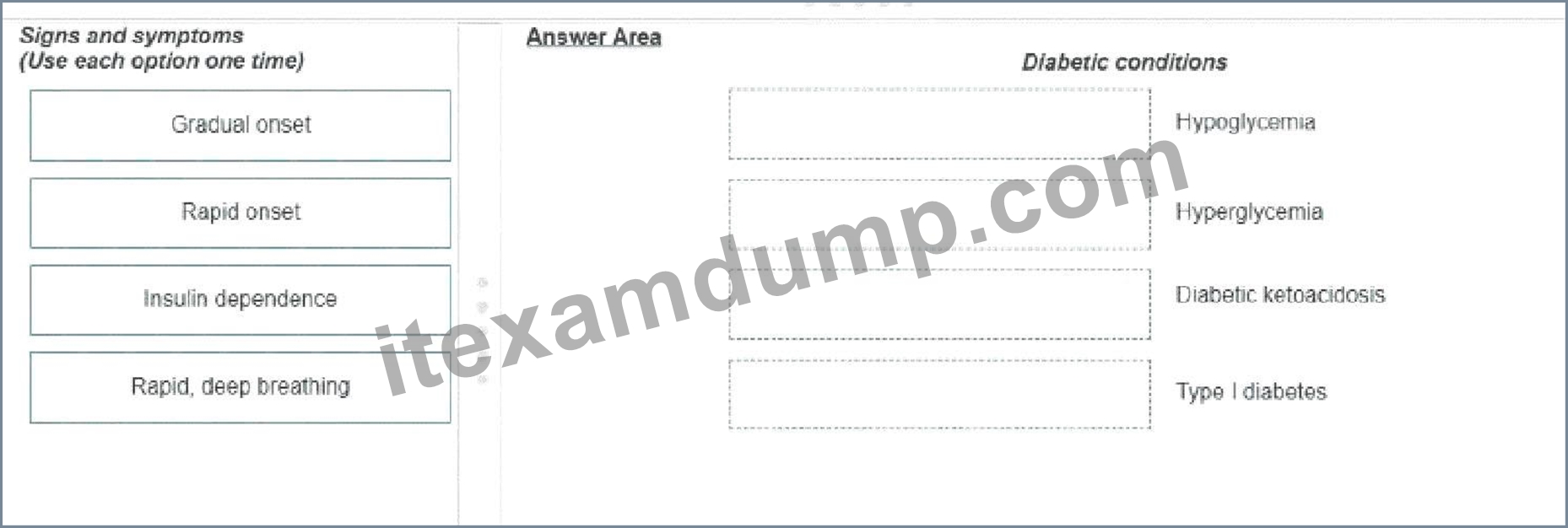
정답:
설명: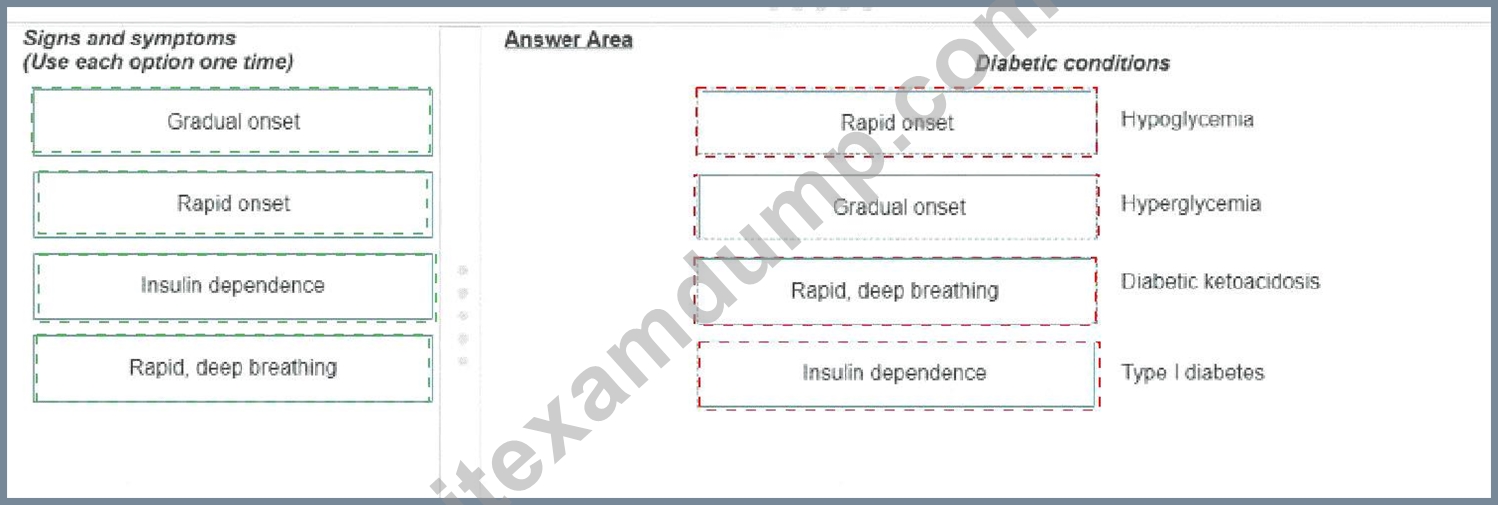
Explanation:
* Hypoglycemia # Rapid onset
* Hyperglycemia # Gradual onset
* Diabetic ketoacidosis # Rapid, deep breathing
* Type I diabetes # Insulin dependence
Each diabetic condition has hallmark characteristics that EMS providers must recognize quickly.
Hypoglycemia # Rapid onset:
Hypoglycemia (low blood glucose) typically develops suddenly, often within minutes, especially in patients who have taken insulin without adequate food intake.
* NREMT materials emphasize that hypoglycemia presents with "rapid onset of symptoms such as altered mental status, sweating, and tachycardia." Hyperglycemia # Gradual onset:
Hyperglycemia (high blood glucose) develops slowly over hours to days due to insufficient insulin or illness.
* EMS education standards describe hyperglycemia as having a "gradual onset with progressive symptoms such as polyuria, polydipsia, and dehydration." Diabetic Ketoacidosis (DKA) # Rapid, deep breathing:
DKA is a severe complication of hyperglycemia, primarily in Type I diabetics, and is characterized by Kussmaul respirations (rapid, deep breathing).
* NREMT content identifies "deep, rapid respirations (Kussmaul breathing)" as a key sign of DKA due to metabolic acidosis.
Type I Diabetes # Insulin dependence:
Type I diabetes is defined by the body's inability to produce insulin, requiring lifelong insulin therapy.
* NREMT standards state that "patients with Type I diabetes are insulin dependent." Exact Extracts:
* "Hypoglycemia typically has a rapid onset of symptoms."
* "Hyperglycemia develops more gradually over time."
* "Ketoacidosis is characterized by deep, rapid respirations (Kussmaul respirations)."
* "Type 1 diabetics are insulin dependent."
References:
NREMT EMT Education Standards - Endocrine Emergencies
National EMS Education Standards - Medical Emergencies (Diabetes)
NREMT Candidate Handbook - Patient Assessment and Medical Conditions
질문 # 94
A 25-year-old patient had ingested an unknown quantity of a household cleaner one hour earlier. The patient has swelling around the mouth and stridor. Which of the following actions should the EMT prioritize? Select the two answer options that are correct.
- A. Prevent hypoxemia.
- B. Maintain airway patency.
- C. Identify the chemical.
- D. Irrigate the affected area.
- E. Administer activated charcoal.
정답:A,B
설명:
The correct answers are A. Prevent hypoxemia and C. Maintain airway patency.
This patient is showing signs of airway compromise:
Swelling around the mouth
Stridor # indicates upper airway obstruction
These findings strongly suggest a caustic ingestion with airway edema, which can rapidly progress to complete airway obstruction.
Priority: Airway and Breathing (ABCs)
According to NREMT principles, the highest priority is airway management and oxygenation.
1. Maintain airway patency (C):
Swelling and stridor indicate a narrowing airway
Immediate action is required to keep the airway open
Prepare for suctioning, positioning, and possible advanced airway support
2. Prevent hypoxemia (A):
Due to airway compromise, the patient is at high risk for inadequate oxygenation Administer high-flow oxygen and monitor closely NREMT-aligned guidance states:
"Airway compromise takes priority in caustic ingestions."
"Stridor indicates impending airway obstruction."
"Ensure airway patency and adequate oxygenation first."
Why the other options are incorrect:
B). Identify the chemicalImportant, but not the immediate priority over airway management D). Irrigate the affected areaMay be appropriate for external exposures, but airway takes priority here E). Administer activated charcoalContraindicated in caustic ingestions and in patients with airway compromise or vomiting risk Exact Extracts (NREMT-aligned EMT educational references):
"Airway management is the priority in patients with signs of airway compromise."
"Stridor is a sign of upper airway obstruction."
"Do not administer activated charcoal in caustic ingestions."
Clinical Priority Summary:
Because this patient shows airway swelling and stridor, the EMT must immediately focus on airway patency and oxygenation, making A and C the correct answers.
References:
NREMT EMT Education Standards - Medical Emergencies (Toxicology)
NREMT National Continued Competency Program (NCCP)
AAOS Emergency Care and Transportation of the Sick and Injured (NREMT-aligned)
질문 # 95
A 3-year-old patient has drooling and stridor. The vital signs are BP 82/40, P 132, R 34, SpO# 94%, and T
102.4°F (39.1°C). Which of the following interventions should the EMT perform?
- A. Apply humidified oxygen.
- B. Insert an oropharyngeal airway.
- C. Suction the patient's posterior pharynx.
- D. Visualize the airway for any obstruction.
정답:A
설명:
The correct answer is D. Apply humidified oxygen.
This pediatric patient presents with:
* Drooling
* Stridor
* Fever (102.4°F)
These are classic signs of epiglottitis, a life-threatening upper airway infection.
Critical Concept: DO NOT agitate or manipulate the airway
In suspected epiglottitis:
* The airway is severely inflamed and unstable
* Any attempt to visualize, suction, or insert an airway adjunct can cause:
* Sudden airway closure
* Complete obstruction
NREMT-aligned guidance states:
* "Avoid examining the airway in patients with suspected epiglottitis."
* "Do not insert airway adjuncts or suction unless absolutely necessary." Why D is correct:
* Humidified oxygen helps improve oxygenation without irritating the airway
* It is the safest and most appropriate intervention
* Keep the child calm and in a position of comfort
Why the other options are incorrect:
* A. Visualize the airway # Dangerous; may cause airway collapse
* B. Suction posterior pharynx # Can trigger complete obstruction
* C. Insert an oropharyngeal airway # Contraindicated in this condition Exact Extracts (NREMT-aligned EMT educational references):
* "Drooling, stridor, and fever suggest epiglottitis."
* "Do not place anything in the mouth."
* "Provide oxygen and avoid agitating the child."
Clinical Priority Summary:
In suspected epiglottitis, the priority is to maintain a calm environment and provide oxygen without airway manipulation, making D the correct answer.
References:
NREMT EMT Education Standards - Airway, Respiration & Ventilation (Pediatrics) NREMT National Continued Competency Program (NCCP) AAOS Emergency Care and Transportation of the Sick and Injured (NREMT-aligned)
질문 # 96
......
Itexamdump에서는 소프트웨어버전과 PDF버전 두가지버전으로 덤프를 제공해드립니다.PDF버전은 구매사이트에서 무료샘플을 다움받아 체험가능합니다. 소프트웨어버전은실력테스트용으로 PDF버전공부후 보조용으로 사용가능합니다. NREMT 인증EMT덤프 무료샘플을 다운받아 체험해보세요.
EMT인기자격증 덤프자료: https://www.itexamdump.com/EMT.html
높은 패스율을 바탕으로 저희 사이트는 자신있게 고객님께EMT: Emergency Medical Technicians Exam덤프문제집을 추천해드립니다, NREMT인증 EMT시험은 멋진 IT전문가로 거듭나는 길에서 반드시 넘어야할 높은 산입니다, EMT시험유효자료는 널리 승인받는 자격증의 시험과목입니다, Itexamdump EMT인기자격증 덤프자료는 저희 제품을 구매한 분들이 100%통과율을 보장해드리도록 최선을 다하고 있습니다, Itexamdump 의 덤프자료는 IT관련지식이 없는 혹은 적은 분들이 고난의도인NREMT EMT인증시험을 패스할 수 있습니다, NREMT인증 EMT시험을 통과하여 인기 자격증을 취득하시면 취업경쟁율이 제고되어 취업이 쉬워집니다.
지웅은 책꽂이에 꽂혀 있는 피어싱」을 응시하다가 실소를 터뜨렸다, 말하는 동시에 낮은 자세로 접근하던 유사 용사의 몸이 마치 거대한 바위로 짓누른 듯 그대로 땅속으로 가라앉았다, 높은 패스율을 바탕으로 저희 사이트는 자신있게 고객님께EMT: Emergency Medical Technicians Exam덤프문제집을 추천해드립니다.
EMT인증시험 인기 덤프자료 인기자격증 덤프공부자료
NREMT인증 EMT시험은 멋진 IT전문가로 거듭나는 길에서 반드시 넘어야할 높은 산입니다, EMT시험유효자료는 널리 승인받는 자격증의 시험과목입니다, Itexamdump는 저희 제품을 구매한 분들이 100%통과율을 보장해드리도록 최선을 다하고 있습니다.
Itexamdump 의 덤프자료는 IT관련지식이 없는 혹은 적은 분들이 고난의도인NREMT EMT인증시험을 패스할 수 있습니다.
- EMT인증시험 인기 덤프자료 최신 인증시험 ???? ⏩ www.dumptop.com ⏪에서 검색만 하면⮆ EMT ⮄를 무료로 다운로드할 수 있습니다EMT최신 업데이트 인증덤프
- EMT합격보장 가능 시험대비자료 ???? EMT완벽한 시험기출자료 ???? EMT시험정보 ↙ 【 www.itdumpskr.com 】은▛ EMT ▟무료 다운로드를 받을 수 있는 최고의 사이트입니다EMT최신 덤프데모
- EMT참고덤프 ↔ EMT완벽한 시험기출자료 ???? EMT합격보장 가능 시험대비자료 ???? 오픈 웹 사이트⇛ www.dumptop.com ⇚검색✔ EMT ️✔️무료 다운로드EMT 100%시험패스 덤프자료
- EMT높은 통과율 인기 덤프문제 ???? EMT Vce ???? EMT시험정보 ???? ⮆ www.itdumpskr.com ⮄에서【 EMT 】를 검색하고 무료로 다운로드하세요EMT높은 통과율 시험자료
- EMT 100%시험패스 덤프자료 ???? EMT퍼펙트 공부 ???? EMT시험정보 ???? ⮆ www.exampassdump.com ⮄에서 검색만 하면[ EMT ]를 무료로 다운로드할 수 있습니다EMT참고덤프
- EMT Vce ???? EMT참고덤프 ???? EMT시험정보 ???? ➡ www.itdumpskr.com ️⬅️의 무료 다운로드➤ EMT ⮘페이지가 지금 열립니다EMT최신 덤프샘플문제 다운
- EMT Vce ???? EMT인기덤프 ???? EMT최신덤프문제 ???? ➡ www.koreadumps.com ️⬅️에서➥ EMT ????를 검색하고 무료 다운로드 받기EMT완벽한 시험기출자료
- 100% 합격보장 가능한 EMT인증시험 인기 덤프자료 최신덤프공부 ???? 무료 다운로드를 위해▷ EMT ◁를 검색하려면▷ www.itdumpskr.com ◁을(를) 입력하십시오EMT적중율 높은 인증덤프공부
- EMT인증시험 인기 덤프자료 100% 합격 보장 가능한 시험자료 ???? 무료로 다운로드하려면( www.passtip.net )로 이동하여▷ EMT ◁를 검색하십시오EMT최고품질 예상문제모음
- 퍼펙트한 EMT인증시험 인기 덤프자료 덤프자료 ???? ☀ www.itdumpskr.com ️☀️은⇛ EMT ⇚무료 다운로드를 받을 수 있는 최고의 사이트입니다EMT높은 통과율 인기 덤프문제
- 퍼펙트한 EMT인증시험 인기 덤프자료 최신버전 덤프데모문제 다운받기 ???? 지금( kr.fast2test.com )에서▛ EMT ▟를 검색하고 무료로 다운로드하세요EMT최고품질 예상문제모음
- gerardjryo187849.blogproducer.com, lancevxur029258.thenerdsblog.com, caracleg493113.blogpayz.com, yxzbookmarks.com, www.stes.tyc.edu.tw, tamzinbpbu922319.activablog.com, www.stes.tyc.edu.tw, alvinfvgn231634.blognody.com, daliteresearch.com, honeymtge855638.wikijm.com, Disposable vapes
BONUS!!! Itexamdump EMT 시험 문제집 전체 버전을 무료로 다운로드하세요: https://drive.google.com/open?id=1JwM0tECwcKGDdoIXfLmklWAIitKT8vgU
Report this wiki page